

Persistent eyes and ears around your offshore assets
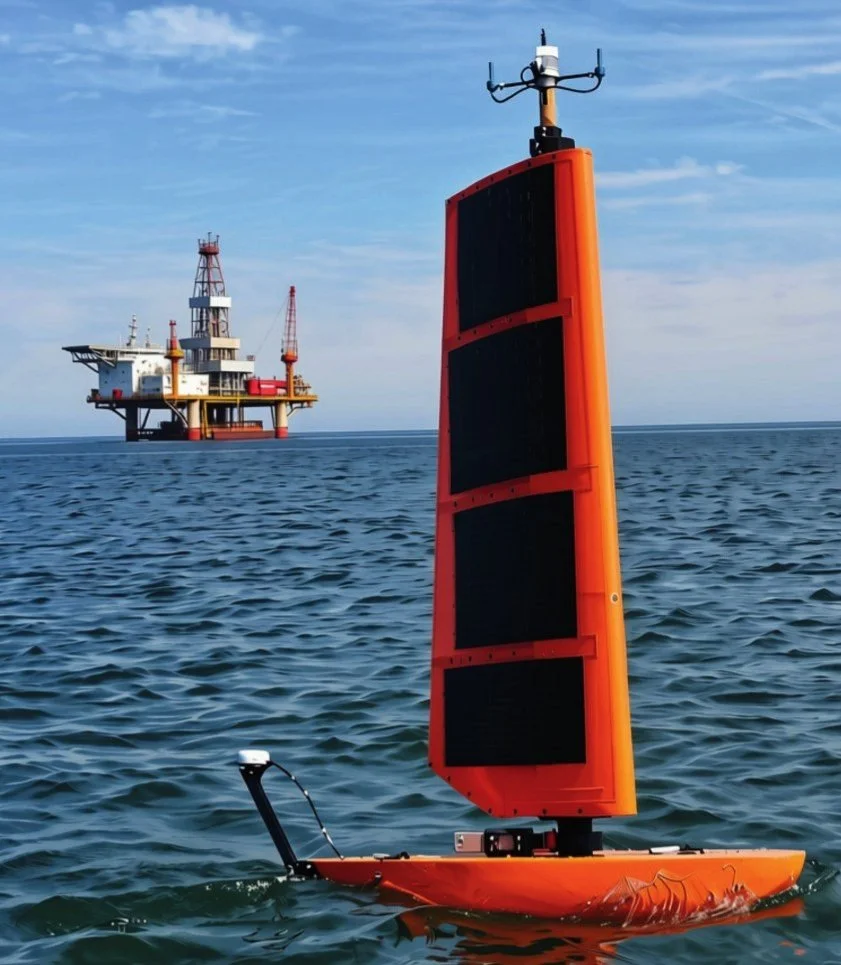
A high-visibility HORUS that patrols safety zones, listens for marine mammals and harvests subsea data for months at a time, on wind and sun, without a crew boat on station.
One vehicle, six offshore jobs
High-current corridors
Uses drift-and-recover transects in strong currents and shallow island channels, with the thruster throttled to keep PAM data clean.
Inspection & anti-piracy
Over-the-horizon remote operation for pipeline and tie-back checks, alongside autonomous perimeter patrols.
Marine mammal PAM
Continuous passive acoustic monitoring before and during deepwater seismic surveys (2,000–3,000 m) and infill drilling, with edge-AI whistle and click classifiers.
Safety-zone patrol
Holds a visual, radar and acoustic presence around 500 m rig safety zones and island transit corridors, tracking vessel traffic to prevent collisions.
Storm evasion & profiling
Submerges to 100 m to ride out hurricanes and squalls, decouple from wave action and profile the water column at multiple depths.
Subsea data gateway
Carries compact ADCPs, or acts as a mobile acoustic relay that harvests data from seabed ADCP frames and tie-back sensors.
From the seabed to your operations center
- SeabedADCP frames & tie-back sensorsRecord current, structure and acoustic data on the bottom.
- HORUSAcoustic harvest & edge AICollects data acoustically, adds its own PAM and camera feeds, and flags what matters.
- LinkSATCOM, cellular or mesh radioBeyond line of sight by satellite; Doodle or Silvus mesh near the asset.
- ShoreYour operations centerWeb GUI and API; one-to-one remote control or one-to-many autonomous fleets.
Built to be seen, and to stay out of the way
Configured for offshore safety: high-visibility hull and wing, AIS, LED navigation lights, a 1080p masthead camera, and above-water microphones and hydrophones for collision avoidance.
It ships in a large palletized shipping box for deployment from platform supply vessels or crew boats at any hub. The box folds flatter for storage when not in use.
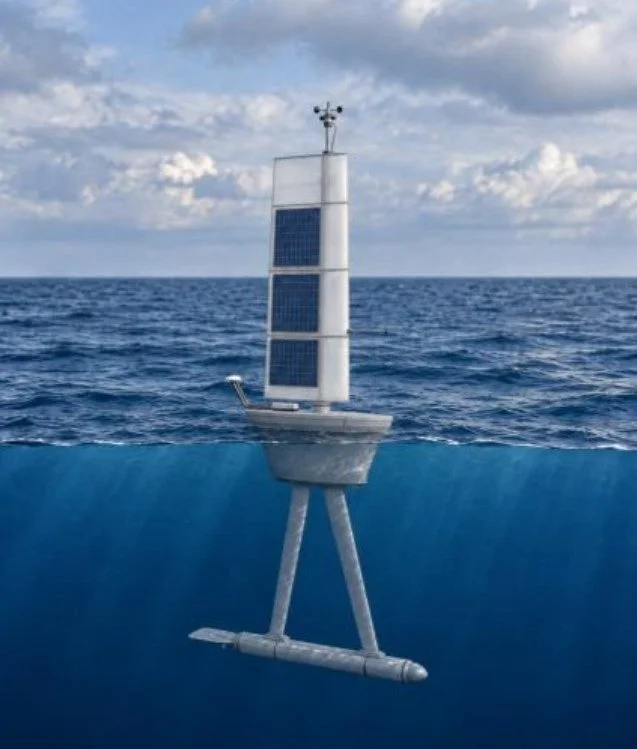
| Size | 353 cm tall (206 above, 147 below waterline) · 180 × 33 cm hull |
|---|---|
| Mass | ≈64 kg base, final mass depends on payload |
| Endurance | 1–6+ months; 11 days on battery alone |
| Power | 1.25 kWh LiFePO4, 24 V · 100 W or 130 W solar wing |
| Acoustics | Hydrophone array, high-frequency loggers, edge-AI whistle/click classifiers |
| Submergence | 100 m; drifts submerged up to 10 days, depending on usage |
| Speed | 0.5–3 kn sailing · 4–6 kn sailing with thruster |
| Payload | 10" × 3.25" dry bay · 20–25 W average, 150 W peak · neutrally buoyant hardpoints |
| Telemetry | BLOS SATCOM · cellular · mesh radio (Doodle, Silvus) |
Fits your field budget, not the other way around
Data as a service
Turnkey: we deploy and operate the vehicles, you receive the data.
Direct purchase
Buy the hardware and run it yourself or through your service provider.
Leased operations
Contractor-owned, contractor-operated (COCO) vehicles on your schedule.
Scope a deployment around your asset
Tell us the location, the asset and what you need to see or hear. We'll come back with a configuration and a contracting model.