

HORUSTM
TRL 7–8 · Accepting ordersSemi-submersible ISR and observation vessel
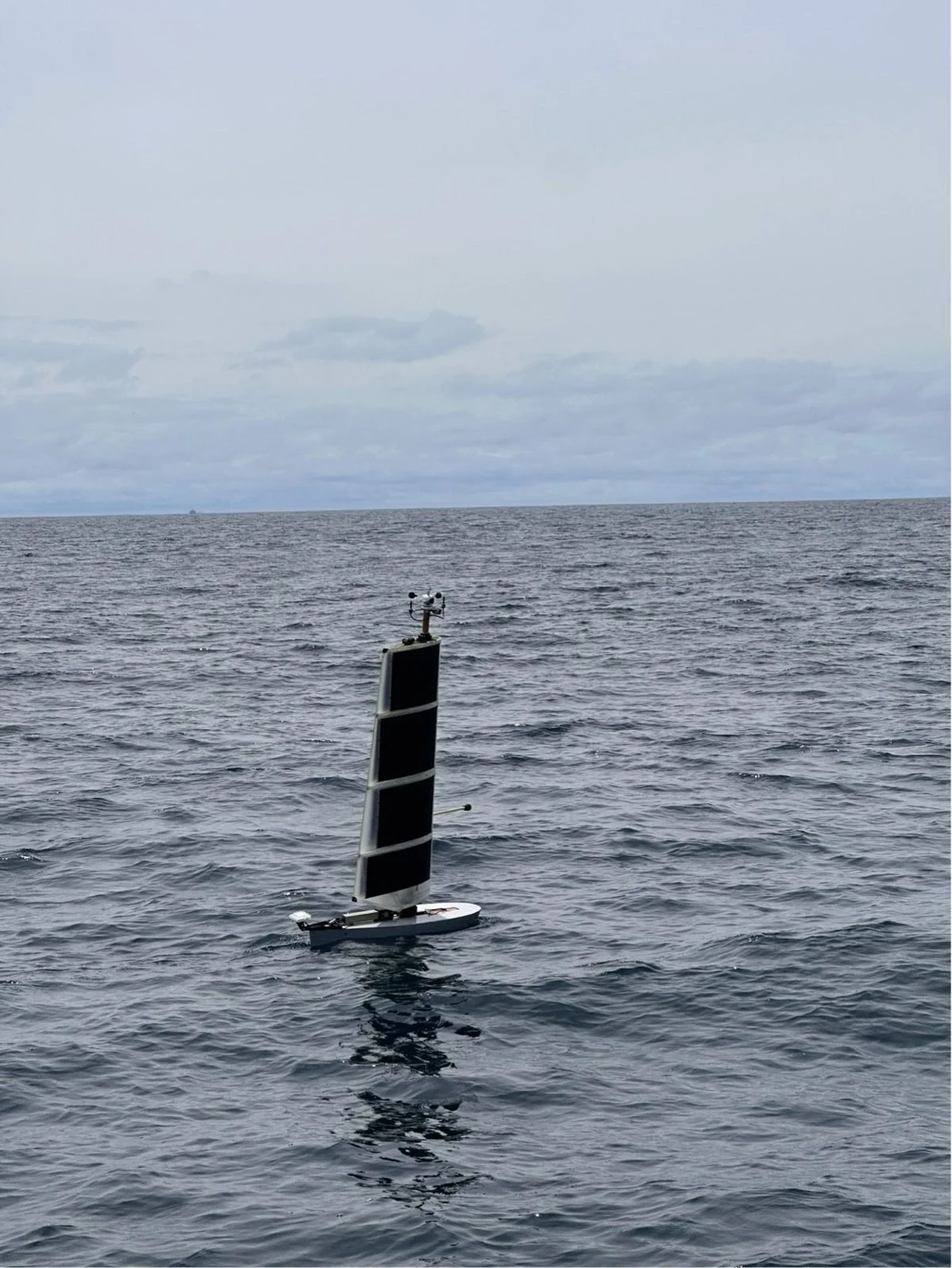
A disruptively affordable, 100% wind- and solar-powered sailing AUSV. It is nearly invisible above water, submerges for extended periods, and keeps working in contested environments. Full autonomy, swarming and manual modes.
Wing above, hull below, payloads in both
Main hull
Two-stage buoyancy system, active wing management, and the main vessel controller with IMU and AIS receiver. Doodle radio standard.
Masthead unit
Anemometer and wind vane, multi-color navigation lights, above-water microphones, 1080p camera, radio and satellite antennas, lightning detection.
Radio box upgrade
Room for additional on-board AI processing and edge computing.
Solar wingsail
3-panel bifacial array, ≈100 W peak; upgrade to 4 panels for ≈130 W. Bifacial cells add 5–20% over rated power.
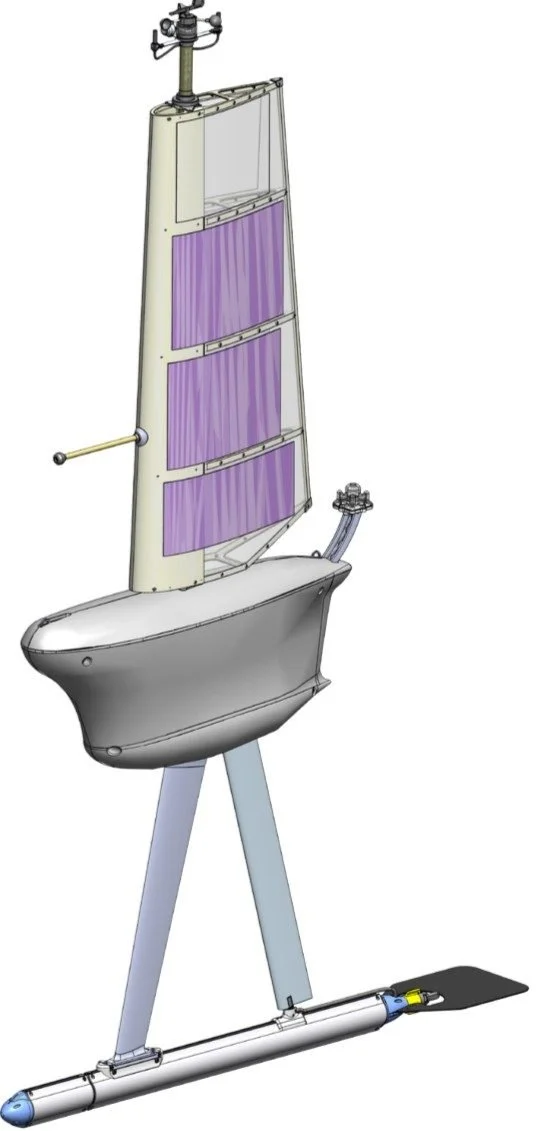
Dry lower payload bay
10" × 3.25" bay with no weight limit as long as it stays neutrally buoyant. Used for acoustic arrays and data collection.
Hull below the surface
Patented. Cuts drag and wake, and keeps the vessel quiet and hard to see.
Keel and keel tube
Rudder actuator, back-up thruster, keel-tube control board, and the LiFePO4 battery (≈1,250 Wh usable, 24 V): 11 days without solar.
Lower external hardpoints
Powered mounts for a small UUV or test equipment, limited only by hydrodynamic shape and neutral buoyancy.
Weather and ocean data from day one
Masthead
Main control computer
Computed on board by the main vessel controller.
Keel tube
Measured below the waterline, and at depth when HORUS dives.
What sets it apart
Adaptive wing management
One electro-mechanical servo sets the wing for every wind condition. No pulleys, no lines.
Submerging
Dives to avoid bad actors and bad weather, and listens underwater while drifting.
Minimal signature
Low acoustic, IR, radar, visual and wake signature by design.
Edge and distributed AI
On-board processing turns sensor data into exception-based reports, not raw streams.
Radio-agnostic comms
Satellite, LTE and mesh radio built in; works with Doodle, Silvus and others.
Scalable
Larger variants can be commissioned for wide-area surveillance or IUU fisheries enforcement.
Specifications
| Item | Specification | Note |
|---|---|---|
| Height | ≈353 cm (139") total: 206 cm above, 147 cm below waterline | Adaptable to other forms; larger variants available. |
| Length × width | ≈180 cm (71") × 33 cm (13") | |
| Mass | ≈64 kg (141 lb) | Final mass depends on sensor payload. |
| Endurance | 1–6+ months | Limited by bio-fouling and long-term UV exposure. |
| Diving depth | 100 m maximum continuous | Up to 10 days submerged, depending on usage. |
From the HORUS cut-sheet, Rev. 28 September 2026. Final mass depends on sensor payload.
Specifications
| Item | Specification | Note |
|---|---|---|
| Wind (primary) | 2–20 kn wind for normal operations | Submerging recommended above 25 kn wind. |
| Thruster (back-up) | Managed by the navigation system | For launch, recovery, transit and no-wind station keeping. |
| Typical sailing speed | 0.5–3.0 kn | While underway and holding course. |
| Max speed, sailing with thruster | 4–6 kn | 40–50 hours with no battery recharge. |
From the HORUS cut-sheet, Rev. 28 September 2026. Final mass depends on sensor payload.
Specifications
| Item | Specification | Note |
|---|---|---|
| LiFePO4 battery bank | ≈1,250 Wh usable, low self-discharge cells | 24 VDC nominal power bus. |
| Solar wing | Standard ≈100 W peak · high-capacity ≈130 W peak | Bifacial cells add roughly 5–20% over rated power. |
| Battery-only operation | Up to 11 days without solar charging |
From the HORUS cut-sheet, Rev. 28 September 2026. Final mass depends on sensor payload.
Specifications
| Item | Specification | Note |
|---|---|---|
| Navigation | Multi-axis IMU with GNSS and inertial dead-reckoning fail-over | |
| Navigation system | On-board navigation and station keeping | Programmable vessel behavior and integrated data recording. |
| Station keeping | 30 m radius | Depends on current and wind. |
| User interface | Web-based chart GUI with integration API | Waypoints, inclusion zones, geofencing, station keeping, status. |
| Manual control | Full manual control by PC or tablet, locally or remotely | Autonomous operation is primary. |
From the HORUS cut-sheet, Rev. 28 September 2026. Final mass depends on sensor payload.
Specifications
| Item | Specification | Note |
|---|---|---|
| Max payload | Subject to form factor, neutral buoyancy and placement | Contact us for detailed payload capability. |
| Peak payload power | 150 W total: 100 W lower, 50 W upper compartment | Flexible and programmable. |
| Continuous average | 20–25 W, 24/7 | Depends on season and latitude. |
| Integration | Fully managed payload communications and power | For external sensors and payloads. |
From the HORUS cut-sheet, Rev. 28 September 2026. Final mass depends on sensor payload.
Specifications
| Item | Specification | Note |
|---|---|---|
| Satellite | Remote command, control and reporting (in masthead unit) | Custom comms can be fitted, temporary or permanent. |
| Mesh radio | Local command, control, mission and reporting | Radio-agnostic: Doodle, Silvus and others. |
| LTE / cellular | Built in | |
| Optional / future | VDES / AIS |
From the HORUS cut-sheet, Rev. 28 September 2026. Final mass depends on sensor payload.
Options and payloads
Deck / hull
Keel
Masthead
Suspended / carried
Standard package
- AIS receiver
- Masthead unit: anemometer, camera, navigation lights, lightning detection
- METOC at launch: wind, air and water temperature, sea state
- Reusable wingsail transport case
- Submergence to 100 m
- Web GUI with integration API
Tested for weeks in a range of sea states, with gusts above 35 kn. Past projects have carried acoustic arrays, a UUV, and CTD and turbidity sensors.
Applications
- Anti-submarine warfare
- C4ISR
- Communications gateway
- EEZ & MPA protection
- EW-related systems
- METOC
- Ocean sensing
- Small UUV delivery and launch
- Targets & decoys
HORUS is accepting orders
Buy outright, lease operations or buy the data. EAR99. UEI HEL6EFFCS3U8 · CAGE 862G1.